
On March 13, 1964, a young woman named Catherine “Kitty” Genovese was brutally attacked and murdered outside her Queens apartment building. The case became legendary not just for its brutality, but for the reported fact that 38 witnesses watched from their windows and did nothing to intervene or even call the police.
While subsequent investigations revealed the original reports were exaggerated, this tragedy sparked the interest of psychologists Bibb Latané and John Darley, who began a series of groundbreaking experiments that uncovered one of social psychology’s most disturbing phenomena: the bystander effect. Their research revealed that the more people who witness an emergency, the less likely any one individual is to help.
The Science Behind the Effect: Why We Freeze
The bystander effect occurs due to several interconnected psychological processes that activate when we’re in a group:
1. Diffusion of Responsibility
In a crowd, individuals feel less personal responsibility to act. The mental calculation shifts from “I need to help” to “Someone else will probably do something.” This sharing of responsibility means that as group size increases, each person feels less obligated to intervene.
2. Social Proof and Pluralistic Ignogeneity
In ambiguous situations, we look to others to determine how to behave. If no one else is helping, we interpret this as evidence that help isn’t needed or that intervention would be inappropriate. This creates a dangerous cycle where everyone assumes the lack of response means the situation isn’t serious.
3. Evaluation Apprehension
People fear making a fool of themselves in front of others. The worry about overreacting, misinterpreting the situation, or performing inadequately can paralyze potential helpers. This is particularly powerful in cultures that place high value on social competence.
4. Audience Inhibition
The presence of others creates concerns about social judgment. People worry about what others will think if they intervene incorrectly or unnecessarily. This social anxiety can override the impulse to help.
Landmark Research: The Science of Non-Intervention
Latané and Darley’s classic experiments demonstrated these mechanisms with alarming clarity:
The Seizure Study (1968)
Participants were placed in individual booths connected by intercom to discuss personal problems. When one participant (actually a confederate) pretended to have a seizure, the response rate dropped dramatically based on group size:
-
When participants thought they were the only witness: 85% helped
-
When they thought one other person was listening: 62% helped
-
When they thought four other people were listening: 31% helped
The Smoke-Filled Room Study (1968)
Participants filling out questionnaires were exposed to smoke seeping under the door:
-
Alone: 75% reported the smoke within 2 minutes
-
With two passive confederates: 10% reported the smoke
-
In groups of three naive participants: 38% reported the smoke
These studies demonstrated that even in clear emergencies, the presence of others significantly reduces helping behavior.
Real-World Examples and Consequences
The bystander effect manifests in various serious situations:
Medical Emergencies
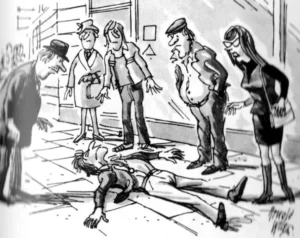
People may collapse in crowded public spaces while bystanders assume “someone more qualified” will help or that the person is simply drunk or sleeping.
Bullying and Harassment
Witnesses to public harassment often fail to intervene, assuming others will step in or that it’s “none of their business.”
Accidents and Crises
In multi-car accidents, witnesses may drive past assuming other drivers have already called for help.
The consequences can be dire: delayed medical attention, prolonged suffering, and in extreme cases, preventable deaths.
Factors That Increase or Decrease the Effect
Several variables influence whether people will overcome the bystander effect:
Factors That INCREASE Helping:
-
Clear and unambiguous emergencies
-
Personal connection to the victim
-
Training in emergency response
-
Smaller group sizes
-
Being in a familiar environment
Factors That DECREASE Helping:
-
Ambiguous situations
-
Large crowds
-
High-risk interventions
-
Being in an unfamiliar setting
-
Presence of apparent “experts”
How to Overcome the Bystander Effect: A Practical Guide
Understanding the psychology behind non-intervention is the first step toward overcoming it:
If You’re a Victim:
-
Make Your Need Clear: Don’t assume people understand you’re in trouble
-
Single People Out: Point to specific individuals and give direct instructions: “You in the red shirt, call 911!”
-
Be Specific: Instead of “Help me!” try “I’m having a heart attack! I need someone to call an ambulance and find my medication!”
If You’re a Witness:
-
Recognize the Effect: Simply knowing about the bystander effect makes you more likely to overcome it
-
Take Responsibility: Decide you will be the one to help
-
Delegate Tasks: Assign specific jobs to specific people: “You call 911, you flag down the ambulance, you keep people back”
-
Don’t Assume Others Are More Qualified: In most emergencies, any help is better than no help
Training and Prevention
Several approaches have proven effective in combating the bystander effect:
Bystander Intervention Training
Programs like the one developed at the University of New Hampshire teach people to:
-
Notice the event
-
Interpret it as an emergency
-
Assume personal responsibility
-
Know how to help
-
Implement the help
Public Education
Simply raising awareness about the bystander effect can increase helping behavior. When people understand why they might not help, they’re more likely to recognize and overcome those barriers.
Organizational Policies
Workplaces, schools, and institutions can create cultures where intervention is expected and supported through clear protocols and training.
The Digital Bystander Effect
The phenomenon has extended into online environments:
Cyberbullying
Witnesses to online harassment often fail to intervene, assuming others will report it or that it’s not their place to get involved.
Social Media Crises
People experiencing mental health crises or broadcasting suicidal thoughts online may receive little intervention from their numerous “friends” or followers.
Overcoming Digital Apathy
The same principles apply online: be specific in requests for help, personally reach out to individuals, and report concerning content through proper channels.
Conclusion: From Bystander to Upstander
The bystander effect reveals a troubling aspect of human nature: our social instincts, which usually serve us well, can sometimes fail us in critical moments. But understanding this psychological trap is the key to escaping it.The Bystander Effect
The research shows that once one person takes initiative, others quickly follow. Your intervention can break the spell of collective inaction. As psychologist Irving Piliavin notes, “The presence of a model, someone who is helping, dramatically increases intervention.”The Bystander Effect
The next time you witness a potential emergency, remember this psychological research. Don’t assume someone else will help. Don’t wait for social proof. Be the one who breaks the pattern. Your action could save a life, and your courage might inspire others to find theirs.
We are all potential bystanders, but we can choose to become upstanders. In that moment of decision, knowledge of this psychological phenomenon might be what empowers you to take action when it matters most.The Bystander Effect

 Editor