
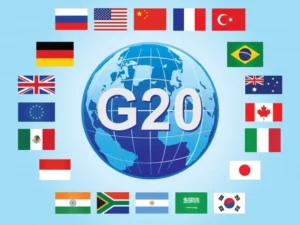
G20 countries The Group of Twenty (G20) is one of the most powerful and influential international forums in the world. Comprising 19 countries and the European Union, along with the African Union as a permanent member, the G20 represents the world’s major advanced and emerging economies. Together, these countries account for around 85% of global GDP, 75% of international trade, and two-thirds of the world’s population. The G20 meets annually at leaders’ summits and frequently through ministerial and working-group meetings to address global challenges.
Since its creation in 1999, the G20 has played a major role in addressing financial crises, designing global economic policies, improving international financial stability, combating climate change, supporting developing nations, and shaping the future of digital and sustainable development. This article provides a comprehensive 1500-word overview of the G20, its history, member countries, objectives, structure, significance, achievements, and challenges.
1. History of the G20
The G20 was established in 1999 in response to the Asian Financial Crisis of 1997–98. World leaders realized that global economic issues could no longer be handled only by the advanced economies of the G7. Emerging economies such as China, India, Brazil, and South Africa were becoming increasingly important in global markets and needed to be included in economic discussions.
Initially, the G20 began as a meeting of finance ministers and central bank governors to discuss and coordinate financial and economic policy. However, after the Global Financial Crisis of 2008, the role of the G20 expanded significantly. The forum was upgraded to a Leaders’ Summit for heads of state, making it the primary platform for managing global economic recovery.
Today, the G20 addresses not only financial issues but also climate change, global health, technology, employment, terrorism financing, energy security, and sustainable development.
2. Member Countries of the G20
The G20 has 20 members, consisting of 19 countries plus the European Union (EU). In 2023, the African Union (AU) was also admitted as a permanent member, further expanding representation.
Here are the 19 individual countries:
-
Argentina
-
Australia
-
Brazil
-
Canada
-
China
-
France
-
Germany
-
India
-
Indonesia
-
Italy
-
Japan
-
Mexico
-
Russia
-
Saudi Arabia
-
South Africa
-
South Korea
-
Turkey
-
United Kingdom
-
United States
And the two organizational members:
-
European Union (EU)
-
African Union (AU)
These countries and unions collectively represent the world’s largest economies, making the G20 one of the most inclusive global governance platforms.
3. Objectives of the G20
The G20 does not have a permanent secretariat or treaty-based structure. Instead, its objectives evolve based on the host country’s priorities and global challenges. However, some long-standing objectives include:G20 countries
1. Ensuring Global Economic Stability
The G20 coordinates macroeconomic policies among major economies to prevent recessions, reduce financial risks, and ensure balanced global growth. This was especially evident during the 2008 financial crisis.
2. Promoting Sustainable Development
The G20 aligns its work with the UN’s Sustainable Development Goals (SDGs), focusing on poverty reduction, sustainable energy, education, and equitable growth.
3. Addressing Climate Change
Climate action is a major G20 priority. Member countries discuss carbon reduction, renewable energy transition, green finance, and climate-resilient infrastructure.G20 countries
4. Strengthening the Global Financial System
This includes reforms in the IMF, World Bank, and global financial regulations to make them more resilient, inclusive, and effective.
5. Enhancing International Trade and Investment
The G20 promotes free, fair, and rules-based trade. It works with the World Trade Organization (WTO) to strengthen global supply chains and reduce trade barriers.G20 countries
6. Supporting Developing Nations
Debt relief, financial assistance, technology transfer, and infrastructure investment are important priorities, especially for nations in Africa and South Asia.
7. Encouraging Innovation and Digital Transformation
In recent years, the G20 has focused on digital public infrastructure, cybersecurity, digital payments, data governance, and the responsible use of AI.
4. Structure of the G20
The G20 operates without a permanent headquarters. Instead, it follows a rotating presidency system, where one member country hosts the summit each year. The presidency sets the agenda and leads all G20 working groups.
1. G20 Leaders’ Summit
This is the highest-level meeting where presidents and prime ministers discuss global issues and finalize official declarations.G20 countries.G20 countries
2. Ministerial Meetings
These involve meetings of:
-
Finance Ministers
-
Central Bank Governors
-
Foreign Ministers
-
Education Ministers
-
Health Ministers
-
Climate and Energy Ministers
They work on sector-specific issues and produce reports and recommendations.G20 countries
3. Sherpa Meetings
Sherpas are personal representatives of leaders who handle negotiations, policy research, and coordination before summits.
4. Engagement Groups
These groups include representatives from business, civil society, youth, women, scientists, and think tanks. Major engagement groups are:G20 countries
-
B20 (Business)
-
C20 (Civil Society)
-
W20 (Women)
-
Y20 (Youth)
-
T20 (Think Tanks)
-
L20 (Labor)
-
S20 (Science)
These groups provide policy recommendations to G20 leaders.
5. Working Groups
Working groups analyze specific areas such as:
-
Climate and environment
-
Digital economy
-
Global health
-
Trade and investment
-
Anti-corruption
-
Infrastructure
-
Employment
5. Importance of the G20
The global significance of the G20 lies in its ability to bring together advanced and emerging economies on one platform. Its importance can be understood through the following points:
1. Represents the Majority of Global Economic Power
The G20 countries collectively dominate the world economy, making their decisions crucial for global financial stability.
2. Rapid Response to Crises
The G20 acted swiftly during the 2008 financial crisis and the COVID-19 pandemic by implementing stimulus packages, supporting vaccine distribution, and stabilizing global markets.G20 countries
3. Enhances Global Cooperation
Unlike the G7, which includes mainly advanced economies, the G20 includes both rich and developing nations, making it more representative.
4. Promotes Sustainable Growth
The organization focuses on renewable energy, climate resilience, food security, and green development.
5. Strengthens Multilateral Institutions
Through the IMF, World Bank, and WTO, the G20 influences international economic rules and financial policies.
6. Key Achievements of the G20
1. Crisis Management
The G20 played a major role in stabilizing the global economy after the 2008 crisis by coordinating stimulus measures and reforming financial markets.G20 countries
2. Paris Climate Agreement (2015)
G20 countries contributed to shaping the global climate agreement and continue to support climate action.
3. Global Minimum Corporate Tax
In 2021, the G20 agreed on a 15% global minimum corporate tax rate to prevent tax evasion by multinational companies.
4. Debt Relief for Poor Countries
During COVID-19, the G20 launched the Debt Service Suspension Initiative (DSSI) to help low-income nations.
5. Digital Public Infrastructure Initiatives
Countries like India promoted digital payments, financial inclusion, and digital identity systems within the G20.
7. Challenges Faced by the G20
Despite its importance, the G20 faces several challenges:
1. Geopolitical Conflicts
Tensions between major powers such as the U.S. and China, and conflicts involving Russia, hinder consensus.
2. Economic Inequality
The G20 must ensure that economic benefits reach developing nations and marginalized populations.
3. Climate Commitments
While climate action is a core priority, many G20 countries struggle to reduce carbon emissions.
4. Fragmentation of Global Trade
Trade wars, protectionism, and supply-chain disruptions remain major concerns.
5. Lack of Enforcement Powers
Unlike the UN, the G20 cannot enforce its decisions; it relies on voluntary cooperation.
Conclusion
The G20 has grown from a small meeting of finance ministers to one of the world’s most important international platforms. With its diverse membership—representing the largest economies, major population centers, and key emerging markets—the G20 plays a crucial role in shaping global economic and political policies. Its influence extends to areas such as climate action, sustainable development, technology, trade, global health, and financial stability.G20 countries
As global challenges continue to evolve—whether economic slowdowns, pandemics, climate change, or geopolitical tensions—the G20 will remain essential for building cooperation and finding solutions. Its inclusive nature and broad representation make it a powerful tool for dialogue, consensus, and action in the 21st century.G20 countries


 Editor