
Branches of Accounts
Accounting is often called the “language of business” because it records, analyzes, and communicates financial information that helps individuals and organizations make informed decisions. Every business—small shop or large corporation—needs a proper accounting system to understand income, expenses, profits, assets, liabilities, and overall financial health.
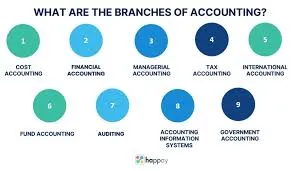
Over time, the field of accounting has expanded into multiple specialized branches. Each branch focuses on a specific type of financial information and serves a unique purpose. Understanding the branches of accounts helps students, professionals, and business owners manage finances more effectively and make accurate decisions. This article explores the major branches of accounting, their importance, and how they contribute to the efficient functioning of an organization.
⸻
1. Financial Accounting
Financial accounting is the most common and widely used branch of accounting. It involves the process of recording, summarizing, and reporting financial transactions of a business.
Key Features:
•Prepares financial statements such as the Balance Sheet, Profit & Loss Account, and Cash Flow Statement.
•Follows accounting principles and standards like GAAP or IFRS.
•Used by outsiders such as investors, banks, and tax authorities.
Importance:
Financial accounting provides a transparent and accurate picture of a company’s financial performance. It helps business owners evaluate profit, loss, financial position, liquidity, and overall stability.
⸻
2. Cost Accounting
Cost accounting deals with identifying, measuring, and analyzing the costs of producing goods or providing services.
Key Features:
•Determines the cost per unit of product.
•Helps control production costs.
•Assists management in pricing decisions.
Importance:
Cost accounting ensures that a business operates efficiently and reduces unnecessary expenses. It is mainly used in industries such as manufacturing, textile, steel, and consumer goods.
⸻
3. Management Accounting
Management accounting focuses on providing financial and non-financial information to managers for decision-making.
Key Features:
•Budgeting and forecasting
•Performance analysis
•Profit planning
•Decision-making techniques
Importance:
Management accounting helps managers plan, control, organize, and evaluate business operations. It is future-oriented and supports long-term strategic decisions such as expansion, investment, and cost reduction.
⸻
4. Tax Accounting
Tax accounting focuses on preparing tax returns and planning tax strategies according to government laws.
Key Features:
•Calculation of income tax, GST, corporate tax, etc.
•Ensures compliance with tax laws.
•Helps reduce tax liability legally.
Importance:
Every business must follow tax regulations. Tax accounting protects companies from penalties, avoids legal issues, and helps in planning finances effectively.
⸻
5. Auditing
Auditing involves the independent examination of financial statements to ensure accuracy and transparency.
Types of Auditing:
1.Internal Audit – Done by the business internally.
2.External Audit – Done by professional auditors.
3.Statutory Audit – Required by law.
Importance:
Auditing increases financial credibility and ensures that a business follows all accounting and tax laws correctly.
⸻
Forensic accounting is the investigation of financial records to detect fraud, corruption, and financial crimes.
Key Features:
•Used in fraud detection
•Helps in legal disputes
•Assists courts and law enforcement agencies
Importance:
Forensic accountants prevent financial losses and maintain ethical business practices. This branch has grown rapidly with increasing corporate fraud cases worldwide.
⸻
7. Government Accounting
Government accounting is used to record and manage financial transactions of government departments and public institutions.
Key Features:
•Maintains public funds
•Ensures transparency in government spending
•Helps in setting government budgets
Importance:
This branch ensures that taxpayers’ money is used properly and that government operations remain transparent and accountable.
⸻
8. Non-Profit Accounting
Non-profit accounting is used by institutions that do not operate for profit, such as NGOs, charities, schools, trusts, and hospitals.
Key Features:
•Focuses on fund management
•Tracks donations, grants, and expenses
•Prepares statements like Receipts & Payments Accounts
Importance:
It ensures that organizations use funds properly and maintain trust among donors and beneficiaries.
9. Social Responsibility Accounting
Also known as Social Accounting, this branch measures the social and environmental impact of a business.
Key Features:
•Corporate social responsibility (CSR) reporting
•Environmental impact analysis
•Community development reporting
Importance:
Social accounting shows how responsible a business is toward society and nature. Many companies today prepare sustainability reports to showcase their contribution to society.
⸻
10. Human Resource Accounting
Human Resource Accounting values and records the cost and contribution of employees in financial terms.
Key Features:
•Measures employee skills, productivity, and experience
•Calculates recruitment and training costs
•Evaluates employee performance financially
Importance:
Employees are assets. Human resource accounting helps organizations improve workforce planning and future HR decisions.
⸻
11. International Accounting
International accounting deals with global business transactions and foreign accounting standards.
Key Features:
•Foreign exchange management
•International taxation
•Cross-border transaction reporting
Importance:
With globalization, many companies operate internationally. International accounting ensures smooth financial operations across countries.
⸻
12. Fiduciary Accounting
Fiduciary accounting handles financial transactions related to estates, trusts, and guardianships. Branches of Accounts
Key Features:
•Manages property, inheritance, and trust funds
•Follows strict legal guidelines
•Used by lawyers, trustees, and estate managers
Importance:
It protects the financial interests of heirs, beneficiaries, and clients.
⸻
13. Fund Accounting
Fund accounting is used by organizations that divide their financial resources into multiple categories or funds. Branches of Accounts
Key Features:
•Tracks each fund separately
•Ensures proper allocation of resources
•Common in universities, churches, and government agencies
Importance:
Fund accounting provides transparency in how money is used for different activities.

Importance of Understanding Branches of Accounts
Understanding the branches of accounting is important for the following reasons: Branches of Accounts
1. Better Financial Control
Different branches help maintain accurate financial records.
2. Improved Decision-Making
Managers can make smarter choices with the help of cost, management, and financial accounting. Branches of Accounts
3. Prevention of Fraud
Auditing and forensic accounting reduce financial fraud and ensure honesty. Branches of Accounts
4. Legal Compliance
Tax and government accounting help businesses follow laws and avoid penalties. Branches of Accounts
5. Business Growth
Proper accounting helps businesses plan growth and future expansion effectively. Branches of Accounts
Conclusion
Accounting is a vast and dynamic field with multiple specialized branches. Each branch plays a vital role in maintaining financial records, detecting fraud, preparing budgets, managing funds, and supporting business growth. Understanding these branches helps students choose the right career path and enables businesses to operate efficiently and transparently. Whether it is financial accounting for reporting, cost accounting for production control, or forensic accounting for fraud detection, each branch contributes to the smooth functioning of an organization. In today’s world, accounting is not just about numbers—it is about analysis, strategy, and responsible financial management. Branches of Accounts


 Surendra