
The Adani Group is one of India’s largest and fastest-growing multinational conglomerates. Focused on infrastructure development, energy, transportation, logistics, ports, airports, and renewable energy, the group has evolved into a global player. Founded by Gautam Adani, the company is built on the principles of nation-building, large-scale vision, and strategic long-term investment.
Today, the Adani Group operates in diverse sectors and plays a crucial role in India’s economic growth, energy security, and digital transformation. This detailed article explores the group’s history, structure, business model, major companies, achievements, controversies, and future outlook.
1. Introduction to the Adani Group
Founded in 1988, the Adani Group began as a commodity trading firm and gradually expanded into multiple sectors. Over the years, the company transitioned from trading to building physical infrastructure—ports, power plants, mines, gas distribution systems, airports, solar parks, and logistics networks.
Key Highlights
-
Headquarters: Ahmedabad, Gujarat
-
Founder & Chairman: Gautam Adani
-
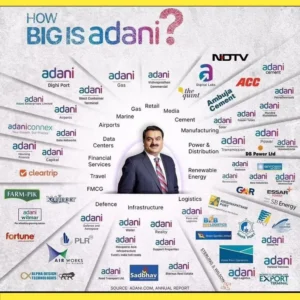
Sectors: Energy, Ports, Airports, Mining, Logistics, Infrastructure, FMCG, Cement, Technology
-
Employees: Over 25,000+ (approx.)
-
Global Presence: Australia, Sri Lanka, Bangladesh, UAE, and others
The Adani Group’s rapid growth is fueled by integration—controlling the entire supply chain from mining to ports, energy generation to distribution, and logistics to trading.
2. History of the Adani Group
1988 – Beginning of the Journey
Adani Exports (now Adani Enterprises) was founded as a commodity trading business focusing on agro-products and polymers.
1990s – Transition to Infrastructure
-
Entered ports business by developing Mundra Port in Gujarat.
-
The port eventually became India’s largest commercial port.
2000–2010 – Rapid Diversification
-
Expansion into power generation, coal mining, and logistics.
-
Introduction of Adani Power and large electricity projects.
2010–2020 – National Expansion
-
Entry into renewable energy with Adani Green Energy.
-
Acquisition of major coal assets in Australia (Carmichael).
-
Entry into city gas distribution.
-
Development of solar manufacturing.
2020–2025 – Becoming a Global Player
-
Rapid expansion in airports management.
-
Growth in data centers and digital technology.
-
Rising investments in green hydrogen and future energy.
This growth places the Adani Group among India’s most influential business conglomerates.
3. Core Philosophy & Business Strategy
The Adani Group follows a unique business model focused on:
1. Vertical Integration
The group controls entire supply chains:
-
Mining → Logistics → Port → Power Plant → Transmission
-
Solar manufacturing → Solar farm → Power distribution
This gives strong cost advantages.
2. Nation-Building Projects
The company invests in:
-
Ports
-
Airports
-
Roads
-
Power infrastructure
-
Renewable energy parks
These directly support national economic development.
3. Large-Scale Vision
Adani focuses on massive, long-term ventures rather than short projects.
4. Public–Private Partnerships
Collaboration with governments for infrastructure development.
5. Sustainability & Green Energy
A major goal is to become the world’s largest renewable energy producer.
4. Major Companies of the Adani Group (Full Breakdown)
The group operates through a wide network of companies; here are the major ones:
1. Adani Enterprises Limited (AEL)
The flagship company acting as the incubator for new businesses.
Key Businesses
-
Mining
-
Airports
-
Data centers
-
Green hydrogen
-
Road projects
-
Defence manufacturing
AEL is the growth engine of the group.
2. Adani Ports and SEZ (APSEZ)
India’s largest private port operator.
Highlights
-
Operates 13+ major ports
-
Mundra Port is the largest in India
-
Handles containers, crude oil, chemicals, and cargo
APSEZ is crucial for India’s export–import logistics.
3. Adani Power
One of India’s largest private power producers.
Focus
-
Thermal power plants
-
Electricity generation
-
Transmission projects
It supplies power to industrial and residential networks across multiple states.
4. Adani Green Energy (AGEL)
A global renewable energy giant.
Achievements
-
Large solar and wind farms
-
One of the world’s biggest renewable portfolios
-
Massive investment in green hydrogen
AGEL plays a major role in India’s clean energy transition.
5. Adani Transmission
Manages transmission lines and electricity distribution.
Supports power supply stability across states.
6. Adani Total Gas
City gas distribution network across India.
Provides:
-
PNG (piped natural gas)
-
CNG for vehicles
7. Adani Airports
Manages India’s major airports.
Airports Operated
-
Mumbai
-
Ahmedabad
-
Lucknow
-
Jaipur
-
Guwahati
-
Thiruvananthapuram
-
Mangaluru
Adani is now the largest private airport operator in India.
8. Adani Wilmar (FMCG)
Producing edible oils and food products under the brand Fortune.
Products include:
-
Cooking oils
-
Basmati rice
-
Wheat flour
-
Soya chunks
-
Ready-to-eat items
9. Adani Cement (Ambuja & ACC)
One of India’s major cement producers after acquisition.
5. Global Projects & International Presence
The Adani Group operates across many countries.
Major international ventures:
-
Carmichael Coal Project (Australia)
-
Abbot Point Port (Australia)
-
Renewable energy partnerships in UAE & USA
-
Infrastructure projects in Sri Lanka & Bangladesh
These strengthen the group’s position as a global infrastructure leader.
6. Contribution to India’s Economy
The Adani Group significantly impacts India’s development.
Contributions
-
Boosts export–import trade
-
Enhances airport infrastructure
-
Supports power and energy distribution
-
Drives renewable energy adoption
-
Generates large-scale employment
-
Strengthens rural-to-industrial connectivity
The group’s ports alone handle a major share of India’s cargo movement.
7. Innovation & Technology in Adani Group
The company is investing heavily in technology:
✔ Smart ports
✔ AI-powered supply chains
✔ Green hydrogen production
✔ Solar manufacturing
✔ Data centers
✔ Electric mobility solutions
Technology is a core part of Adani’s future strategy.
8. Challenges & Controversies
Like any major conglomerate, the Adani Group has faced challenges.
Common issues:
-
Market volatility
-
Debt concerns
-
Criticism from environmental groups
-
Regulatory reviews
The group has consistently responded by strengthening governance, improving transparency, and focusing on sustainability.
9. Future Plans of the Adani Group (2025 & Beyond)
The Adani Group is focused on long-term goals:
1. Becoming the world’s largest renewable energy company
Massive investments in solar, wind, and green hydrogen.
2. Expanding airports network
More modernization and new terminals.
3. Large data center parks
To support India’s digital future.
4. Growth in FMCG & consumer goods
Expansion of Fortune brand products.
5. Strengthening infrastructure
More ports, power plants, and logistics hubs.
6. Green mobility initiatives
EV infrastructure and charging networks.
10. Conclusion
The Adani Group represents modern India’s ambition for large-scale infrastructure, renewable energy leadership, and global reach. From a small trading business to a multi-sector conglomerate, the group’s growth is driven by strategic vision, strong execution, and nation-building philosophy.
Whether in ports, airports, energy, FMCG, or technology, the Adani Group continues to expand its presence and play a crucial role in shaping India’s future.


 Editor