
The Nifty 50 index is one of India’s premier stock market benchmarks. It is managed by NSE Indices, a subsidiary of the National Stock Exchange of India (NSE). The index consists of the 50 largest and most liquid stocks listed on the NSE, covering a wide cross-section of sectors and representing a broad measure of the Indian equity market.
Launched on 22 April 1996 (base date 3 November 1995 = 1000), the Nifty 50 has become a widely used reference for institutional and retail investors alike Because of its size, liquidity and diversification, movements in the Nifty 50 are seen as reflective of the overall health of India’s stock market and economy.
Why Nifty 50 Matters
-
Market benchmark: It is the go-to gauge of market performance in India. When media reports “the market rose” or “the market fell”, often they are referring to Nifty‐50.
-
Investment tool: Many index funds, ETFs and passive investment products track the Nifty 50, making it critical for investment portfolios.
-
Macro indicator: Because it includes major companies across key sectors, its movement often hints at broader economic trends (corporate earnings, consumer demand, capital flows).
-
Derivative trading: Futures & options on Nifty 50 are among the most traded derivatives in India, making it central to trading strategies and hedging.
Composition & Methodology
The Nifty 50 is a free‐float, market‐capitalisation weighted index. That means firms are included based on their size and free share availability, and each company’s weight in the index is proportional to its market cap (subject to certain rules).
Some key points:
-
It includes 50 of the largest listed companies on the NSE, across sectors such as banking, IT, consumer goods, energy, infrastructure.
-
It is reviewed periodically for inclusion/exclusion of stocks, so that it stays representative and maintains liquidity.
-
Because it is broad but focused, it covers about ~60%+ of free‐float market cap of NSE listed equities.
How Nifty 50 Works & Tracks Market Sentiment
When we watch the Nifty 50’s live value, we are seeing a cumulative reflection of how its 50 constituent companies are doing. Here’s how to interpret it:
-
If Nifty 50 rises, it typically means broad investor confidence: companies’ earnings expectations are positive, capital flows into equities are strong, or macro signals are favourable.
-
If Nifty 50 falls, one or more of those conditions may be under pressure: e.g., weak corporate results, high inflation, interest rate concerns, global risk off.
-
Because the Nifty 50 is large‐cap focused, it is often less volatile than small/mid-cap indices, but still sensitive to major developments.
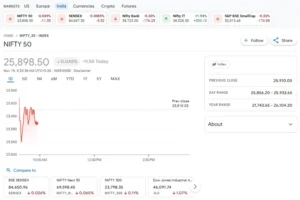
For example, as per live data, the Nifty 50 was trading around 25,910.05 with a decline of about -0.40%. Its 52‐week range is approximately 21,743.65 to 26,104.20.
Today’s Nifty 50 Update
Here’s a snapshot of where the Nifty 50 stands today and what’s driving the move:
Current Level & Performance
-
The index is currently around 25,910 as noted earlier.
-
According to NSE live data, it logged around 25,895.00 at 09:24 am IST, with a small dip of about -15.05 points (-0.06%). The slight decline today reflects mixed global cues and sectoral rotations.
Key Drivers of Today’s Movement
-
According to one report, optimism around second‐quarter corporate earnings lifted market sentiment, causing the Nifty to surpass the 25,950 level recently.
-
On the flip side, concerns about global markets, export sector headwinds, and uncertainties around trade and monetary policy are acting as moderating forces.
-
In addition, valuation pressures in certain sectors such as IT and export‐oriented companies are seen as potential drags.
Sectoral Highlights
-
Financials/banking indices have shown strength, helping underpin the Nifty’s performance. For example, the bank index hit a new high in one session of recent days.
-
Export‐oriented sectors like IT may lag due to global demand concerns and currency pressures.
-
Domestic consumption driven sectors (consumer goods, FMCG, auto) are being watched closely for signs of recovery.
What to Watch
-
Domestic institutional investor flows remain crucial. If domestic flows are strong, they can offset foreign outflows.
-
Global cues: US interest rates, commodity prices, currency movements (INR vs USD) all weigh on market sentiment.
-
Corporate earnings results: Upbeat earnings from large Nifty firms often spark broader confidence.
-
Technical levels & support/resistance: For example, some analysts point to 25,800 as a near‐term support zone.
-
Policy announcements: Moves by the Reserve Bank of India (RBI), government spending, regulatory changes play a role.
What Drives Nifty 50 Over the Longer Term
Corporate Earnings
Ultimately, companies in the index deliver profits (or losses). Earnings growth or margin pressure can impact valuations heavily. A sustained earnings up-trend usually propels the index.
Macro Environment
Factors such as GDP growth, inflation, interest rates, fiscal policy matter. For instance, if inflation is high and rates are expected to rise, equities may suffer. Conversely, rate cuts or fiscal stimulus can boost them.
Capital Flows
The Indian market is influenced by both domestic and foreign institutional flows. Large FPI outflows can put pressure, domestic retail/SIP flows can provide support. Recycling of global capital also matters.
Valuations & Sentiment
At any time, the index level partly reflects what investors are willing to pay for future earnings—so valuation expansion (higher P/E multiples) can lift the index even if earnings growth is moderate.
Sector Rotation
Since Nifty 50 covers many sectors, shifts in which sectors investors prefer (for example from IT to financials or from cyclical to defensive) will change the index’s path.
Key Metrics, Technicals & Levels for Nifty 50
-
52-week high: ~26,104.20.
-
Recent swing area: ~25,800-26,000 – this has emerged as a near base/resistance zone. According to analysts, the index bounced from lower levels recently and may either continue upward or consolidate around this supply zone.
-
Seasonality: Historical data show 9 out of last 17 years, Nifty 50 gave positive returns in November. Average November change ~ +1.02% historically.
Important Considerations for Investors
Risk Management
Even though the Nifty 50 comprises large cap stocks, this does not make it risk‐free. Market corrections do happen, and large swings can occur if global or domestic shock hits. Investors should maintain diversified portfolios, use stop-losses if trading, and keep a long-term perspective if investing.
Long‐Term vs Short‐Term
-
For long‐term investors: Keeping exposure to the Nifty through index funds or ETFs is a cost‐effective strategy to capture broad market growth.
-
For short‐term traders: Watching technical levels, sector performance, F&O data (open interest, put‐call ratios) can help identify trade opportunities.
-
Market timing is hard. Focus on consistent investment (via SIPs), and avoid reacting excessively to daily noise.
Allocation & Diversification
Relying purely on Nifty means exposure to only large caps. For broader diversification, consider mid‐caps, small‐caps, or thematic sectors, balanced with risk appetite.
Macro & Valuation Awareness
Keep an eye on macroeconomic indicators, corporate earnings releases, and valuations. High valuations mean less room for error; slower earnings growth or adverse macro news can lead to sharp corrections.
What Lies Ahead: Outlook for Nifty 50
Several analysts and institutions are bullish on the medium‐term prospects for the Nifty 50. For instance, global investment bank Goldman Sachs recently upgraded India’s equity market outlook to “overweight” and set a target for Nifty 50 at ~29,000 by end of 2026 (implying ~14% upside)
Key themes that could support this view:
-
Improving corporate earnings momentum, especially in domestic‐facing sectors such as consumption, banking, auto.
-
Policy tailwinds, including possible rate cuts by RBI, deregulation, and infrastructure push.
-
Strong domestic investor flows (retail/SIP) supporting the market.
-
Valuation gap narrowing with other emerging markets making India relatively more attractive.
However, headwinds remain: global interest rate uncertainties, export slowdown, currency depreciation, commodity inflation, geopolitical risks. A sustained upside will require favourable alignment across multiple variables.
FOR MORE INFO CLICK TO START BUTTON

 Editor