
CAC Have you ever tried to sell lemonade at a stand? You need lemons, sugar, and cups. You have to buy those things before you can sell even one glass. In the big world of businesses, like the apps on your phone or the websites you visit, they have a special cost too. It’s not for lemons, but for customers. This cost has a special name: CAC.
CAC stands for Customer Acquisition Cost. That’s a big, fancy phrase, so let’s break it down like a puzzle.
-
Customer: A person who buys something from you.
-
Acquisition: A big word that just means “to get” or “to win.”
-
Cost: How much money you spend.
So, CAC is simply: “How much money does a company spend to get one new customer to buy something?”
Think of it like a game. The prize is a new customer. The money you spend on advertising, special offers, and salespeople are your “game tokens.” CAC tells you how many tokens you used to win that prize.
Chapter 1: The Lemonade Stand – Seeing CAC in Action
Let’s go back to your lemonade stand. You want more kids on your street to come buy your drink.
-
You Make Posters: You spend $5 on colorful paper and markers to make posters that say, “Best Lemonade Here! Only $1!”
-
You Give a Free Sample: You spend $2 on tiny cups to let kids try a sip for free, hoping they’ll come back to buy a full cup.
-
You Tell Your Friends: You don’t spend money here, but you spend your time telling everyone at school about your stand.
At the end of the week, you count your money. You spent $7 on posters and samples (your “tokens”). You look at your list and see that because of those posters and samples, 7 new kids came to your stand for the first time.
How do you find your CAC?
Total Money Spent to Get Customers: $7
Number of New Customers You Got: 7 kids
CAC = $7 ÷ 7 kids = $1
Your Customer Acquisition Cost is $1. You spent $1 in your “game” to win each new customer.
This is a super important number! Why? Because your lemonade sells for $1 a cup. If it costs you $1 just to GET a customer (your CAC), and then you only make $1 from them, you haven’t made any profit! You’re just breaking even. You’d need to sell them a second cup, or a cookie, to actually make money.
Chapter 2: How Do Big Companies “Spend Tokens” to Get Customers?
Big companies play the same game, but with different kinds of “tokens.” They add up ALL the money they spend on anything that brings in new people. This usually includes:
-
Advertising Money: TV commercials, YouTube ads, Instagram promotions, billboards, and Google ads.
-
Marketing Team Salaries: The money paid to the people whose job is to think of cool ads and campaigns.
-
Special Offers & Discounts: “First month free!” or “Get 20% off your first order!” These discounts are a cost to get you.
-
Sales Team Costs: Paying the people who call or email potential customers to convince them to buy.
-
Software & Tools: The cost of programs that send emails or manage social media.
Let’s take a simple example: “AppyFun,” a game on your tablet.
In one month, AppyFun spends:
-
$30,000 on Instagram and TikTok ads.
-
$15,000 on the salaries for its two marketers.
-
$5,000 on a “100 free coins for new players!” offer.
-
Total Spent on Getting Customers: $50,000
That month, because of all that work, 50,000 new people download and start playing AppyFun.
What is AppyFun’s CAC?
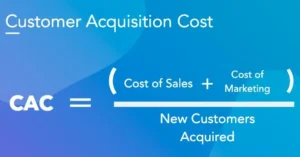
Total Money Spent: $50,000
Number of New Customers: 50,000 players
CAC = $50,000 ÷ 50,000 = $1
So, AppyFun spends $1 to acquire each new player. Now they know their magic number.
Chapter 3: Why is CAC Such a Big Deal? The LTV Best Friend
Knowing your CAC is like knowing the price tag on a new customer. But a price tag alone doesn’t tell you if it’s a good deal. Is a $5 chocolate bar a good deal? It depends! If it’s tiny, it’s a bad deal. If it’s huge and lasts a week, it might be a great deal.
For businesses, the “size of the chocolate bar” is another magic number called LTV.
LTV stands for Customer Lifetime Value. This means: “How much money will one customer spend with us over the entire time they are our customer?”
Let’s go back to AppyFun. They spend $1 to get a new player (CAC = $1). That player might buy coins in the game. If they buy $2 worth of coins in their first week and then never play again, the company made a $1 profit ($2 – $1 = $1). That’s okay.
But what if that player loves the game? They play for 6 months, buying a few coins every week. Over all that time, they spend a total of $30 on the game.
Now let’s compare:
-
CAC (Cost to Get Them): $1
-
LTV (Total Money They Spend): $30
This is a fantastic deal! The company paid $1 to make $30. That’s like using one game token to win a giant stuffed animal prize.
The Golden Rule: For a business to be healthy and grow, the LTV must be HIGHER than the CAC. A good rule of thumb is that LTV should be at least 3 times the CAC.
If CAC is higher than LTV, it’s an emergency! It means the company is spending more to get a customer than the customer will ever pay back. It’s like spending $10 to win a $5 prize. You’d run out of money very fast. This is why CEOs and investors watch CAC so, so closely.
Chapter 4: How Do Companies Try to Lower Their CAC?
A lower CAC means you’re getting customers for less money. That’s like finding a cheaper way to buy your game tokens! How do they do it?
-
Making Customers Happy (The Best Trick!): The cheapest way to get a new customer is through your existing happy customers. If you love AppyFun and tell your friends, and they join, that costs the company $0! This is called referral or word-of-mouth. Its CAC is basically zero!
-
Finding the Best Ads: Companies test different ads. Maybe a funny ad on TikTok gets more customers for less money than a boring ad on a website. They put their money where it works best.
-
Making Their Product Shine: If a website or app is easy and fun to use, more people who try it will stick around and buy. This means the ads work better, lowering the CAC.
Conclusion: CAC is the Heartbeat of a Business
So, what is CAC? It’s not just a boring business number. It’s the scorecard of the customer game.
-
It tells a company if their way of finding new customers is smart or wasteful.
-
It must always be compared to LTV (the customer’s value) to see if the game is worth playing.
-
It pushes companies to make better products and happier customers, because that’s the cheapest way to grow.
The next time you see a “First Month Free!” offer or a fun ad for a new app, you can smile. You’re not just seeing an ad—you’re seeing a company spending its CAC, playing its tokens in the giant, exciting game of winning you as a customer. And now, you know the rules.


 Editor